


Before & After Gallery
Anthony's Chesnut Journey
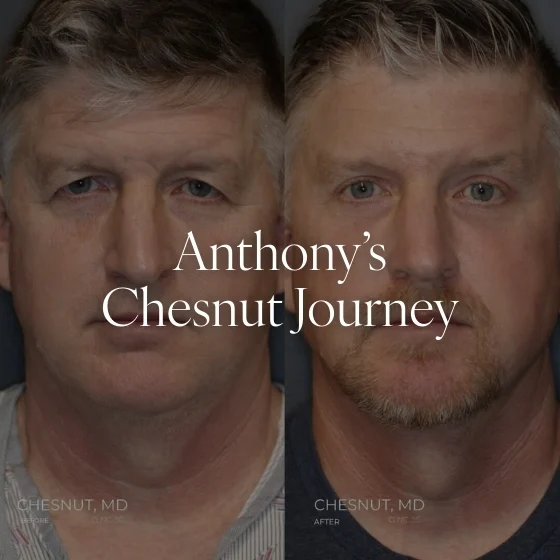
Meet Anthony
Anthony had a deadline. His daughter’s wedding was a few weeks out, and he had decided that it was time. Not just because of the event, though that gave the timing a certain clarity, but because the event made concrete something he had been aware of for a while: the face he saw in the mirror was no longer the one he carried in his mind.
What he wanted was specific and carefully considered. He wanted to look in the mirror and see something that reflected the way he actually saw himself, the way he felt on the inside. He was not looking to be transformed. He was not looking to look younger in some generic sense. He was looking to look like himself, a fresher, more vital version of the person he had always been, without any evidence of how that had been achieved.
He had found this practice the way many thoughtful patients do: by looking at results. He had seen that the outcomes here maintained the person’s essence and identity while consistently producing something refreshed and more alive. That quality, the preservation of identity alongside genuine improvement, was the thing he was looking for and the thing he was not willing to compromise on.
Anthony arrived with three concerns that are worth naming directly because they are among the most common and most legitimate fears that male patients bring to a consultation about facial rejuvenation.
The first was changing his baseline masculine look. He had a rugged character to his face that was part of how he moved through the world, and the idea of emerging from surgery with that quality diminished or softened was genuinely unacceptable to him. This is not vanity. It is identity. A man’s face, particularly one that carries the kind of presence Anthony’s did, is not simply an appearance. It is a form of communication, and altering it in ways that misrepresent the person is a real and consequential risk in male facial surgery.
The second was not recognizing himself afterward. This fear is closely related to the first but distinct from it. It is the concern that the result, even if technically successful, will produce a stranger in the mirror rather than a familiar face. It speaks to the neurological dimension of self-image, the way the brain holds and recognizes its own face, and it is a concern that deserves to be taken seriously rather than dismissed as unreasonable anxiety.
The third was looking like he had something done. For Anthony, a visible result was a failed result, regardless of its technical quality. The work had to be invisible in its execution and natural in its outcome. Anything less would have defeated the purpose.
All three fears pointed toward the same surgical philosophy: enhance, preserve, and leave no trace.
Anthony’s timeline added a specific dimension to the planning process. With his daughter’s wedding only a few weeks after his procedure, recovery was not simply a medical consideration.It was a logistical one with real stakes. He needed to be genuinely present atone of the most significant events of his life, looking well and feeling himself, without carrying the visible signs of recent surgery.
The optimized recovery protocol was central to making that timeline viable. This is not a standard post-operative care plan. It is a carefully constructed stack of recovery modalities designed to accelerate healing, reduce inflammation, and support tissue recovery in ways that standard protocols do not address. For Anthony, with a fixed and non-negotiable event on the calendar, it was what made the difference between a timeline that was possible and one that was not.
The procedures themselves were also selected with the timeline in mind. Every element of his plan was minimally invasive by design, performed without screws, pegs, or hardware of any kind, using bony anchors that provided durable structural support without the recovery burden of more invasive approaches. The durability was not a concession to the timeline. It was the standard the plan was held to regardless. Anthony would be enjoying these results for the rest of his life, and the plan was built accordingly.
- EnigmaLift invisible access browlift with bony anchors, no screws or pegs
- Upper eyelid rejuvenation with masculine character preservation
- Stem Cell Rich Fat Transfer to the cheeks and lower face
- Customized laser resurfacing treatment
Procedural Plan: Revealing What Was Always There
Anthony’s plan was focused on the upper face, with the brow and upper eyelids as the primary targets and the cheeks and lower face addressed through volume restoration rather than structural lifting. This concentration of effort reflected where his most significant aging changes had occurred and where the correction would have the most meaningful impact on the overall impression his face made.
The brow lift was performed through invisible access, using bony anchors to achieve durable repositioning without any of the hardware that traditional approaches require. The structural support this provides is lasting rather than temporary, and the absence of screws or pegs means the result integrates with his anatomy rather than depending on foreign material to maintain its position over time.
The upper eyelid surgery worked in concert with the brow correction, addressing the skin and contour changes that had accumulated above his eyes while carefully preserving the lid character that defined his rugged masculinity. This is the combination that most commonly produces feminization when it goes wrong in male patients, and the reason it goes wrong is usually an overcorrection of one or both elements. The calibration here was precise: enough correction to restore alertness and open the eye area, not enough to soften the quality that made his eyes distinctly his.

The stem cell rich fat transfer addressed the volume changes in his cheeks and lower face that had contributed to the overall aged impression without being the primary source of it. Fat transfer was chosen for the same reason it is consistently preferred in male patients: it is permanent, requires no maintenance, and integrates with the surrounding tissue in a way that reads as natural rather than added. The cheeks gained subtle fullness and the lower face regained structural support, both in ways that complemented the upper face correction rather than competing with it.
The customized laser resurfacing completed the plan at the surface level, addressing skin quality and texture in a way calibrated to his specific needs rather than applied as a standard treatment. The goal, consistent with the overall philosophy of his plan, was not to erase every line but to restore strength, resilience, and vitality to the skin itself.
When Anthony saw his results for the first time, his reaction was immediate and specific: he said it looked like photos of him in his 20s.
That response is worth sitting with for a moment, because it reveals something true about what successful rejuvenation actually accomplishes. The goal was never literally to make him look 25. But the fact that his own neurobiology, the part of his brain that holds and recognizes his self-image, responded to the result by reaching back to his younger self suggests that what the surgery restored was not an arbitrary improvement but something he had been carrying in his internal image of himself all along. The aging changes had obscured it. The surgery uncovered it.
He made the wedding with time to spare, recovered and present and looking exactly as he had hoped: refreshed, vital, and entirely himself. The three fears he had brought into the consultation were all, in the outcome, unrealized. His masculine character was intact. He recognized himself. And nobody could tell.
The results he is enjoying now were built to last. The bony anchors holding his brow correction in place require no upkeep. The fat transfer has integrated permanently. The laser work has strengthened his skin in ways that will continue to serve him as he ages forward. He came in with a deadline and a clear set of goals. He left with a result designed to hold up well past both.
Anthony’s story is, at its core, about recognition. The recognition he wanted to see in the mirror. The recognition his own brain offered him when he first saw the result. And the recognition, quiet and unremarked upon, that he received at his daughter’s wedding from everyone around him who simply saw a man who looked well, without knowing why.
That last form of recognition is the goal every time. Not a result that announces itself, but one that allows the person to simply be present, looking the way he feels, without the gap between the two demanding any further attention.
For Anthony, at his daughter’s wedding, that is exactly what he had.


.avif)
Ready To Start Your Journey?
Fax: (844) 961-3417