


Before & After Gallery
Bill's Chesnut Journey
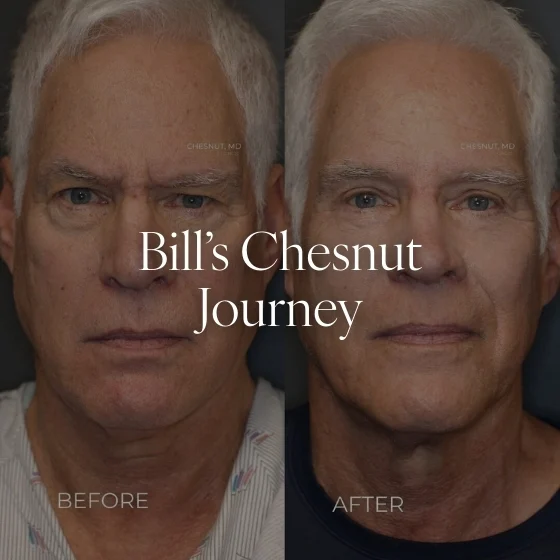
Meet Bill, Age 67
Bill spent a career being watched. As a former NFL athlete, his entire professional life unfolded under scrutiny, in stadiums, on film, in highlight reels. He is 67 now, still an athlete by every meaningful measure, still physical and present and fully engaged with the demands of performance. What brought him into the consultation room was not vanity. It was the same instinct that had always driven him: the desire to show up at his best.
His concerns were specific and focused. He wanted to look more awake. The changes around his eyes had accumulated over decades, and they no longer reflected the energy and alertness he brought to everything else in his life. He also carried something he had lived with far longer than any aging change: acne scarring that had bothered him since his youth. And during the course of his care, a skin cancer on his glabella was identified and addressed. Three distinct concerns, each meaningful in its own right, handled together in a coordinated plan.
What made Bill’s case particularly instructive was the consideration that shapes every decision in male facial rejuvenation: masculinity has to be preserved, not just respected in theory but protected in practice, at every step. The bone structure, the facial proportions, the quality of presence that defines a strongly masculine face cannot be softened or feminized in the course of improving it. Bill exemplified this challenge and its solution.
Upper and lower eyelid work in a male patient operates by a fundamentally different set of principles than it does in a female patient. The goals are not simply adjusted versions of the same targets. They are categorically distinct. Where the female eye area often benefits from opening, brightening, and softening, the male eye area requires rejuvenation that reads as rested and vital without crossing into territory that looks altered, refined, or in any way inconsistent with the underlying facial architecture.
For Bill, this meant the plan had to accomplish meaningful correction while leaving his facial shape exactly as it was. His was a strongly masculine baseline, and the surgical approach had to work within it rather than impose anything on top of it. The most successful result would be one that nobody could explain, one that simply made him look like the best version of himself rather than like someone who had undergone a procedure.
His upper lid concerns centered on contour evenness and the sinking of the brow fat pad that had contributed to the heaviness above his eyes. His lower lids carried genetic fat pad puffiness that had deepened the orbital shadow and created the appearance of fatigue. Together, these changes were aging him in ways that his energy and physicality consistently contradicted. The goal was straightforward: close the gap between how he presented and how he actually was.
The acne scarring was a separate concern but one with real emotional weight. It had been part of his face for the entirety of his adult life, through his NFL career and everything that followed. Addressing it alongside the eye procedures made both practical and personal sense, using the same stem cell harvest and laser work that would support the cosmetic result to target the scarring that had never been adequately treated.
The surgical plan for Bill was built around a commitment to minimal intervention and maximum effect. Every decision was evaluated against the same standard: does this add meaningful improvement, and does it do so without leaving evidence of itself behind?
His upper eyelid correction would be performed through a single access point, with the brow fat pad addressed through the same incision rather than requiring any additional entry. This kind of efficiency is not simply a technical preference. It is a direct expression of the invisible access philosophy: fewer access points means fewer opportunities for visible evidence, and combining work through shared incisions is one of the ways that comprehensive correction can be achieved with minimal surface disruption.
The lower eyelid correction would be performed entirely without external incisions, repositioning the fatpads from the inside to smooth the lower lid contour and fill the tear trough. The stem cell rich fat transfer would address volume loss and deliver regenerative support to the areas of acne scarring. The optimized laser cocktail would work alongside it, targeting both the scarring and the normal aging changes in his skin. And the Mohs micrographic surgery for his basal cell carcinoma, identified on his glabella, would be integrated into his overall care.
- EnigmaLift upper eyelid rejuvenation with contour correction
- Brow fat pad repositioning through shared upper eyelid incision
- Scarless lower eyelid bag removal with fat pad repositioning and tear trough correction
- Stem Cell Rich Fat Transfer for volume restoration and acne scar treatment
- Laser Resurfacing for acne scar treatment and aging changes
- Mohs micrographic surgery for basal cell carcinoma removal on the glabella

Procedural Plan
Bill’s surgery was designed to accomplish several distinct goals through the fewest possible access points, with each element of the plan supporting the others rather than existing independently.
The upper eyelid work corrected the contour irregularities that had developed over time, evening the lid margin in a way that restored a more alert and symmetrical appearance. The brow fat pad, which had descended and contributed to the sense of heaviness above his eyes, was addressed through the same incision rather than through a separate approach. The result was a lift in the upper eye area that read as natural wakefulness rather than surgical intervention.
The scarless lower eyelid correction repositioned the fat pads from the inside, eliminating the puffiness beneath his eyes and using the repositioned volume to fill the tear trough and soften the orbital shadow. This combination, upper lid contour correction and lower lid fat repositioning, addressed the full circumference of his eye area in a coordinated way that produced a result greater than either procedure would have achieved alone.
The stem cell rich fat transfer served a dual purpose. It restored volume in areas that had lost it with age, and it delivered a concentrated regenerative treatment to the acne scarring that had been present for decades. Paired with the optimized laser cocktail, which targeted both the scarring and the broader surface aging of his skin, the treatment addressed a concern that purely cosmetic procedures would never have reached. For Bill, seeing meaningful improvement in those scars at one month was one of the most personally significant moments of his entire recovery.
The Mohs surgery for his skin cancer was performed as part of his overall care, ensuring that a medical concern identified during his evaluation was treated with the same precision and thoroughness applied to everything else.
One week after surgery, Bill’s recovery was progressing exactly as expected. The early swelling was present and appropriate, and the result was not yet visible beneath it in its final form. What was already clear, even at this early milestone, was the absence of any visible access points. The work had been done, comprehensively, and the skin showed no evidence of how.
At one month, Bill was already noticing a dramatic difference in his scars. This was the outcome that surprised him most, not because the cosmetic improvement wasn’t meaningful, but because the acne scarring had been a fixed feature of his face for so long that significant improvement had not fully felt possible. The stem cell treatment and laser work had produced visible results faster than he had anticipated, and his enthusiasm about it at the one month mark was genuine and unguarded.
By four months, the full picture was coming into view. The eye area was rejuvenated in the way the plan had intended: awake, vital, and unmistakably masculine. The brow sat at a natural position. The lower lids were smooth. The orbital shadow that had made him look tired was gone. And his facial shape, the strongly defined structure that had always been the foundation of his appearance, remained exactly as it had always been. Nothing had been softened. Nothing had been feminized. The masculinity of his face was intact, and the aging changes that had accumulated around it had been addressed cleanly and completely.
The skin cancer treatment added a dimension to his four month update that extended beyond the cosmetic. He had come in wanting to look more awake and to address his scarring. He left having also had a medical concern identified and treated. That combination, aesthetic optimization and genuine health care delivered in parallel, is a meaningful part of what comprehensive patient care can look like when it is done thoughtfully.
At four months, with the healing still in progress, every cosmetic procedure he had undergone remained invisible on the surface of his skin. No scars. No evidence of access. Only the result, standing entirely on its own.
Bill came in as an athlete, and he approached his care the way athletes approach everything: with seriousness, with a clear goal, and with the discipline to trust a process rather than look for shortcuts. He wanted to look as good as he felt, to close the gap between his energy and his appearance, and to address a few specific things that had bothered him for longer than the aging changes alone.
At four months, those goals are met. His eyes are open and alert. His scars are measurably improved. A skin cancer has been treated. And not one of those outcomes left a visible mark on the surface of his face.
Male facial rejuvenation done well does not look like anything. It looks like a man who takes care of himself, who ages with intention, and who shows up looking exactly the way he feels. That is Bill at four months, and the result will only continue to refine itself from here.


.avif)
Ready To Start Your Journey?
Fax: (844) 961-3417