


Before & After Gallery
Julie's Chesnut Journey
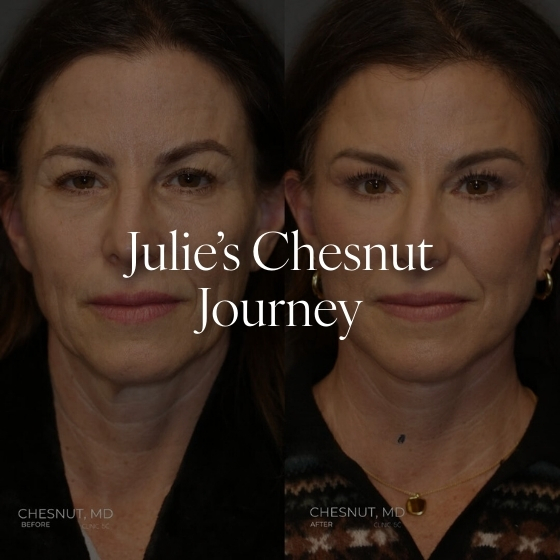
Meet Julie, Age 53
“I focus on my sleep. I eat well. I train to be strong. And I came to you to make sure I look as good as I feel.”
Some patients walk into a consultation having already done the work. Not the surgical work, but the deeper work: the discipline of sleep, the consistency of training, the intentionality of nutrition. Julie was one of those patients.
At 53, she had spent years building and maintaining a version of herself she was genuinely proud of from the inside out. What brought her in wasn’t dissatisfaction with her life, but rather, a specific and articulate frustration: her face had stopped keeping up with how she felt.
She had traveled to the West Coast from the East Coast after finding this practice through the Gabby Reece podcast, which is a detail worth noting, because it speaks to the kind of research Julie brings to every decision she makes. She wasn’t looking for a quick fix. She was looking for the right answer, and she had done the work to find it.
Her concerns were precise. Early jowling. Loss of jawline definition. And something subtler but deeply personal: the feeling that her eyes disappeared when she smiled. That last one mattered most. It wasn’t vanity. It was identity. She wanted the expression on her face to reflect the energy behind it.
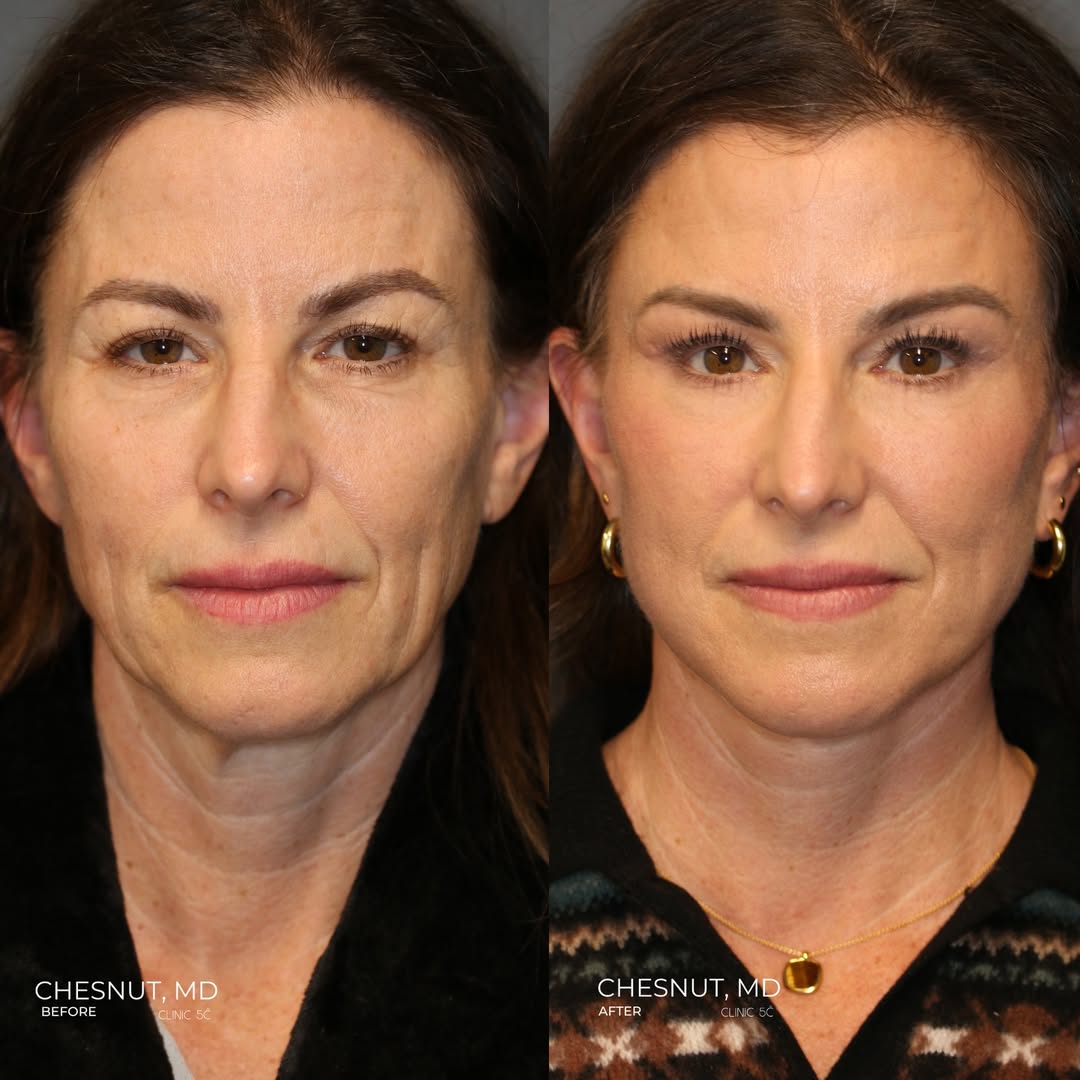
Julie’s consultation began with an important clarification. She had been told before that her concerns were a matter of too much fat or too much loose skin. That's the kind of assessment that tends to lead toward surface-level treatments or reductive procedures. That framing wasn’t accurate, and acting on it would have produced the wrong result.
What was actually happening in her face and neck was structural. Gravitational. The deep plane architecture that supports the jawline and mid face had shifted over time, pulling everything subtly but meaningfully downward. No laser devices aimed at the surface of the skin could address that. No focused ultrasound, no radio frequency treatment, no filler used to camouflage the change would restore what had moved. The correction had to happen at the level of the problem.
This is where the philosophy that guides every EnigmaLift® procedure becomes most relevant. The goal was never to pull or to hollow or to dramatize. It was to reposition, restore, and elevate. Ultimately, to bring the deep structural elements of her face back to where they belonged, without overcorrecting in ways that look age-inappropriate or artificial. Julie’s anatomy called for comprehensive work. Her mindset was ready for it.
One additional element made her case particularly interesting. Julie’s ptosis (the drooping of her upper eyelids) was one of the more complex aspects of her surgical plan, even if it would ultimately be one of the least visually obvious outcomes. The correction was complicated by unique and dynamic factors in both her lower eyelids and her brow position, requiring precise calibration. And while the neck and jawline transformation tends to dominate the before-and-after conversation, it’s the eye correction that people actually see when they encounter her in real life.
Her previous upper eyelid surgery also factored into the plan, requiring revision work alongside the new procedures. Every decision was made with the full picture in mind.
Julie’s surgical preparation included a full assessment and mapping of the deep structural changes driving her concerns. The plan that emerged was as thorough as any we undertake, covering every layer of the face and neck from brow to jawline, and addressing both the structural and qualitative dimensions of her aging.
One component of her plan extended beyond the face entirely. Because fat harvesting was already part of the surgical process, her own fat-derived stem cells were prepared for an additional purpose: a hip joint injection to address her osteoarthritis, performed under ultrasound guidance by Dr. Christopher Meadows while she was already under anesthesia. This kind of whole-patient thinking (using what the surgical process already produces to address concerns elsewhere in the body) reflects the broader philosophy of optimization that Julie herself brought into the consultation.
Recovery planning was built into the process from the beginning. Julie committed fully to our next level recovery protocol, a proactive and comprehensive approach to healing that goes well beyond standard post-operative care. The distinction matters: there is aversion of recovery that prioritizes short-term comfort above all else, relying on corticosteroids to reduce swelling quickly. That approach works in the immediate term. It also inhibits the regenerative process that is central to long-term results.
Julie understood the tradeoff and chose the path that would serve her best over time.
1. Invisible access, deep plane facelift with deep neck contouring
2. Enigmalift browlift, upper eyelid correction from previous surgery
4. Stem Cell Rich Fat Transfer
6. Hip Joint Stem Cell Injections


Procedural Plan
Julie’s surgery was designed as a true full facial rejuvenation. It was not a collection of independent procedures layered on top of one another, but a coordinated plan in which each element addressed a specific anatomical layer and worked in concert with everything around it.
The foundation was the EnigmaLift® deep plane, preservation-style face and neck lift. This is the correction that addressed the structural displacement driving her jowling and jawline loss, which targeted the repositioning of the deep muscles, glands, and structural elements of her neck rather than simply tightening skin over them. The difference between these approaches is visible in the results over time: preservation-style deep plane work moves with the face naturally, ages with integrity, and avoids the overcorrected or hollowed appearance that can emerge when the neck and jawline are sculpted too aggressively.
Above the jawline, invisible access brow support addressed the descent that had been contributing to the heaviness in her upper face. Upper eyelid revision, ptosis repair, and scarless lower eyelid rejuvenation worked together to open and balance the eye area. This targeted correcting the specific concern she had named at the outset, the disappearing eyes when she smiled, while also addressing the subtler ptosis that was quietly affecting her overall expression.
Stem cell–rich fat transfers stored volume selectively, using her own harvested fat in a way that supports skin quality and long-term tissue health rather than simply adding bulk. Manual filler removal cleared the accumulated product from previous treatments, ensuring the new structural work could settle naturally without prior filler distorting the outcome. The customized laser resurfacing addressed the top dimension of her result, refining skin texture and tone in a way that complements the deeper structural changes rather than existing independently of them.
Julie’s recovery was, from the beginning, a study in transparency. She documented it honestly, including the in-between moments that most patients keep private. That willingness to show the real process, including the parts that are less comfortable to share, made her journey one of the most instructive records of what full facial rejuvenation actually looks like from the inside.
At three weeks, she was already out and about, moving through her daily life thoughtfully rather than hiding from it. Makeup covered a great deal at this stage, which made her "without-makeup" documentation at this milestone unusually valuable. Swelling was present, as it should be, and the deeper healing work was well underway.
By four weeks, the early trajectory was clearly positive. The deep structural elevation of her neck was already becoming visible. The muscles, glands, and underlying architecture were beginning to reveal the repositioning that had taken place. Some swelling remained, particularly beneath the chin, which is exactly where it tends to persist longest given the nature of the tissue involved.

Eight weeks post-op brought an update both with and without makeup, again a rare and genuine look at the healing process in real time. She looked and felt well, with the most significant remaining swelling concentrated in the neck. This is a consistent pattern in this kind of deep plane work, where the muscular tissue heals at a slower pace than skin or fat.
This is the pattern that repeats at every milestone through the middle phase of recovery: skin inflammation resolves first, followed by the fat compartments, with the muscular structures lagging behind. It’s not a complication. It’s the expected sequence of tissue healing, and understanding it is part of what allows patients to move through that period with the right expectations.

There is also a phase in the recovery arc that deserves its own acknowledgment.
In the weeks between roughly four and ten weeks post-surgery, patients enter what might be called the chrysalis phase.
This is a period where the proliferative work of healing is happening most actively beneath the surface, even as the visible changes feel slow or incomplete. It can be one of the more mentally challenging stretches of recovery. It is also one of the most important. The discipline of this phase, of trusting the process rather than shortcutting it, is where the long-term result is quietly being built.
At four months, the transformation continued to clarify. The before-and-after comparison at this milestone included photos taken at home by Julie alongside clinical photos, in both repose and while smiling, which shows the full range of expression that a result has to hold up across. Her left brow showed the kind of asymmetry that is part oft he normal evolution at this stage, and was already stabilizing on its own timeline. The neck still carried some visible swelling in the muscular layer. Both were expected.


By five months, the healing was approaching a more stable state. The redness that characterizes earlier recovery had faded significantly. The swelling beneath the chin (the myositis, or muscle inflammation, from the deep neck lift) was still present but measurably reduced. The overall contour of her jawline and neck was becoming increasingly defined.


At seven months, the question that tends to come up with full facial rejuvenation results is when the patient becomes “red carpet ready.” It is, genuinely, a subjective question. Different observers will mark different moments as the threshold.
However, the more meaningful question is when Julie felt ready. That answer comes from within the result itself, not from a comparison photo. By seven months, her face was moving naturally. Her expressions were authentic. The jawline and neck she had come in hoping to restore were present and stable, and the eye area (the detail she had named as most personal to her) was open, balanced, and unmistakably hers.
A close look at this milestone still reveals a hint of residual swelling in the deeper muscular structures of the neck, which is myositis that continues to resolve on its own schedule. This is not a limitation of the result. It is the result still arriving. The healing process is not linear, and the most refined details of full facial rejuvenation tend to show themselves last.


Julie came in with a clear and honest self-assessment. She had done everything right in the domains she controlled: sleep, nutrition, training, mindset. She wanted her appearance to reflect that investment. Not to look younger in some generic sense, but to look as good as she felt: fully aligned, inside and out.
At seven months, that alignment is visible. The jowling is gone. The jawline is defined without being overworked. The eyes open fully when she smiles. And the neck (the area where deep plane results take longest to fully declare themselves) continues to refine.
What makes Julie’s journey worth following is not just the outcome. It’s the honesty with which she documented the path to it.
Recovery is not a two-week process. It is not something that can be meaningfully shortcut. It is something that rewards patience, discipline, and the willingness to trust a process even when the most important work is happening where you can’t yet see it.
That is exactly the mindset Julie brought to this from the very first conversation. And it is exactly what her result reflects.
.avif)
Ready To Start Your Journey?
Fax: (844) 961-3417