


Buccal Fat Pad vs. Perioral Mounds: Why the Distinction Matters More Than You Think
.png)
By Dr. Cameron Chesnut | Five Codes Podcast | OR Diaries
Few areas in facial aesthetics generate more confusion, and more avoidable surgical mistakes, than the lower face. Specifically: the fullness that can form around the corners of the mouth, below the lips, and along the lower cheeks as we age.
Patients come in describing it in different ways. Some call it "chipmunk cheeks." Others say their face looks heavy or jowly around the mouth. Some have been told they need buccal fat removal. Some have already had it done and are now worse off than before.
The problem, almost always, is that two anatomically distinct structures are being confused for one another: the buccal fat pad and the perioral mounds. Treating one when the problem is the other doesn't just fail to help. It can cause lasting damage that's harder to correct than the original concern.
What Is the Buccal Fat Pad?
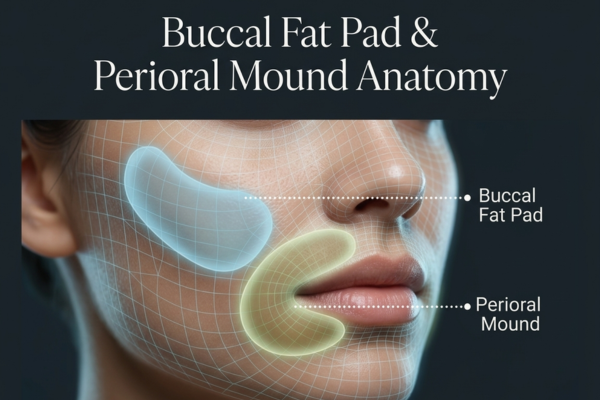
The buccal fat pad is a deep, encapsulated fat structure that lives inside the cheek, roughly at the level of where your upper and lower teeth meet when you close your mouth. It's not superficial tissue. It sits beneath the buccinator muscle, the membrane lining the inside of the cheek. If you've ever accidentally bitten the inside of your cheek, you've bitten the housing that surrounds it.
It's one of the few fat pads in the face that has a defined capsule, which means it behaves more like an organ than a diffuse layer of fat. It also extends well beyond the cheek, reaching up into the temporal region and wrapping around some of the muscles involved in chewing and jaw movement. Babies have large, prominent buccal fat pads, which is part of what gives infant faces their characteristic roundness and fullness.
Over time, gravity and the loss of structural support cause the buccal fat pad to descend. As it moves inferiorly and anteriorly (forward and downward) it can bunch at the corner of the mouth, creating visible fullness in the lower face. Simultaneously, it leaves a hollow behind in the space it vacated, which can cause the midcheek to look gaunt or deflated.
For a deeper read: Stuzin JM, Rohrich RJ, Dayan E. The Facial Fat Compartments Revisited. Plastic and Reconstructive Surgery, 2019. (PubMed)
What Are Perioral Mounds?
Perioral mounds are an entirely different structure. They sit more superficially, closer to the skin surface, and are located at the corners of the mouth, between the end of the nasolabial fold and the lower cheek. They don't have the defined capsule of the buccal fat pad. The fat here is thinner, less discrete, and overlies the SMAS layer (the same deep facial tissue layer addressed in facelift surgery).
Perioral mounds are caused by a combination of factors: bone resorption in the jaw over time, descent of superficial fat pads from above, and the constant mechanical force of the muscles surrounding the mouth, particularly the orbicularis oris. They tend to become more visible with age and are sometimes described as "mouth pouches" or the fullness that sits just below and to the sides of the lips.
Perioral mounds sit between the lower edge of the cheek fat compartments and the fat compartments that form the jowls, and they can become fuller and droopier with age. They are frequently confused with both jowls and buccal fat.
For a deeper read: Gu Y et al. Efficacy and Safety of Perioral Mound Region Liposuction. Aesthetic Surgery Journal, 2023. (PubMed)

Why Confusing the Two Is a Problem
This is where the clinical consequences become significant.
Buccal fat removal, which involves surgically excising the fat pad through an incision inside the mouth, has become a popular procedure, particularly over the last several years. In the right patient, with genuine buccal fat excess and good facial volume overall, it can produce elegant results. But it is frequently performed on patients whose actual problem isn't the buccal fat pad at all.
When someone in their 40s or 50s presents with lower face fullness or heaviness around the mouth, and buccal fat removal is performed, two things can go wrong simultaneously. First, the buccal fat that was removed was actually providing structural support, acting as a three-dimensional buttress to the surrounding facial architecture. Removing it can accelerate the skeletal look of facial aging that most patients are trying to avoid. Second, if the real culprit was a perioral mound, the thing the patient actually came in for is still there, now surrounded by a face that has less volume to balance it.
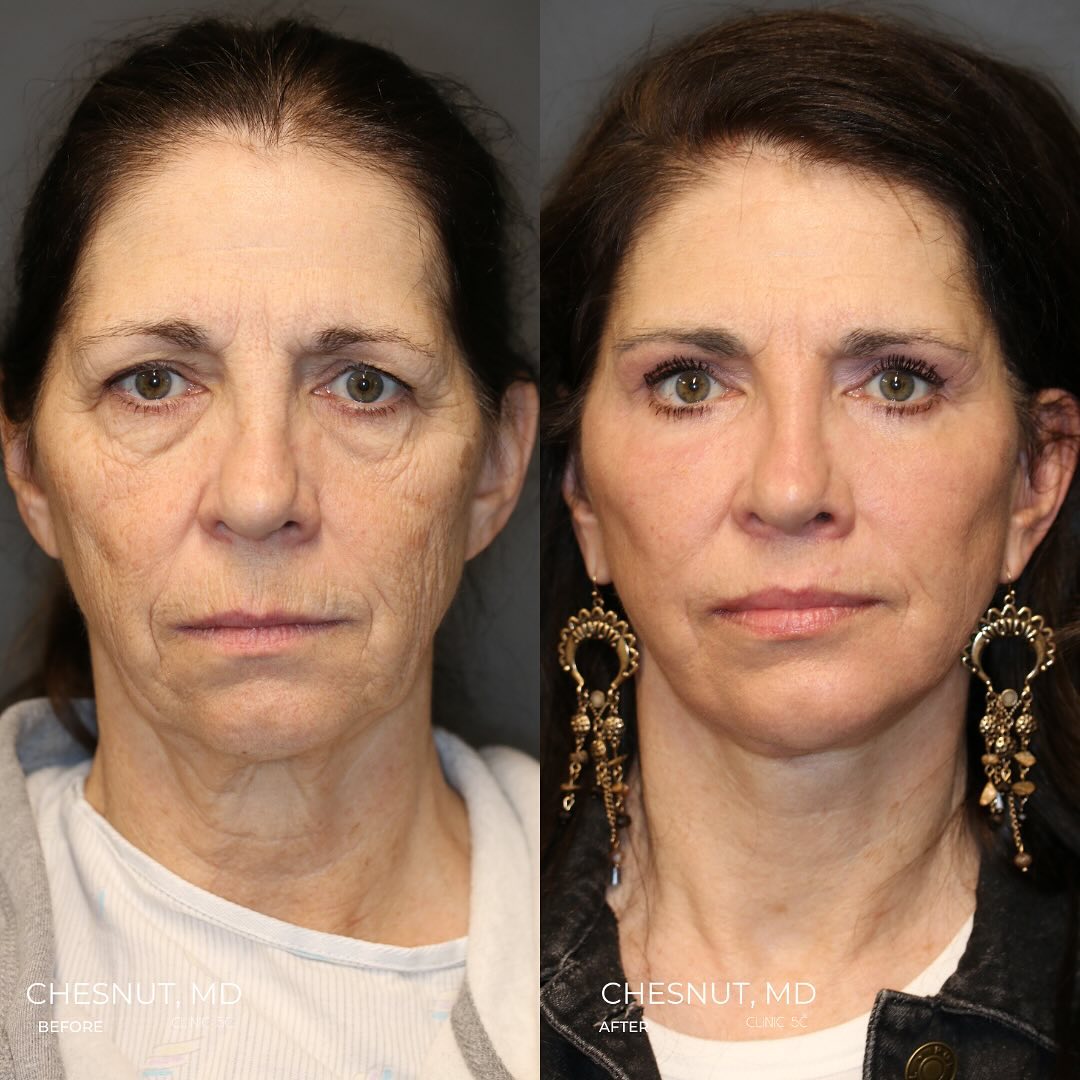
The patient described in this episode had already had her buccal fat pad removed before coming to see me. She was in her fifties, her buccal space was already naturally lean, and the fullness she had originally sought treatment for was a perioral mound, completely unrelated to the buccal fat pad. The removal of her buccal fat didn't address her concern. It created a hollowing in the wrong place and left the actual issue untreated.
The Case for Lifting Rather Than Removing
My approach to the buccal fat pad is not to remove it. It's to put it back where it came from.
The descent of the buccal fat pad is a gravity problem, not an excess problem. The fat was in the right place when it was higher. It's the migration downward that creates the appearance of fullness at the wrong level. Excising it eliminates volume that was doing useful structural work and discards it permanently. Lifting it repositions the fat back into the space it vacated, restoring structure where it's needed and reducing the bunching where it isn't.
This approach is consistent with a broader principle in how I think about facial rejuvenation: almost nothing should be removed and discarded. The volume was put there for a reason. The job is to understand where it came from and return it, not to chase a surface-level contour change by subtraction.
For perioral mounds, the treatment calculus is different because the anatomy is different. There's no capsule to lift, and the tissue is in a zone of high muscular activity. But here too, the right answer depends entirely on accurately identifying what's actually there: is this descended fat from above, a true perioral fat accumulation, muscle bunching from the orbicularis, or some combination? Treatment that doesn't start with that answer is guesswork.
Frequently Asked Questions
What is the difference between buccal fat and perioral mounds?
The buccal fat pad is a deep, encapsulated fat structure inside the cheek at the level of the molars, extending into the temporal region. It descends with age, causing lower face fullness. Perioral mounds are a separate, more superficial fat layer located at the corners of the mouth, between the nasolabial fold and the lower cheek. They are caused by different factors and require different treatments. The two are commonly confused, and treating one when the other is the problem produces poor results.
Should I get buccal fat removal if I have fullness around my mouth?
Not necessarily, and possibly not at all. Fullness around the mouth is more often related to perioral mounds or descended facial fat than to true buccal fat excess. Buccal fat removal in a patient who doesn't have genuine buccal excess, particularly in middle age or beyond, can create hollowing and accelerate the skeletal appearance of facial aging. Before pursuing any removal procedure, the anatomy needs to be correctly identified. The fullness you're seeing may be in a completely different structure than the one being proposed for treatment.
Can buccal fat removal make you look older?
Yes, in the wrong patient. The buccal fat pad contributes to the three-dimensional fullness of the midface. In younger patients with significant buccal excess, removal can create a more defined appearance. But as faces age and naturally lose volume, the buccal fat pad becomes part of what maintains a healthy, non-skeletal facial structure. Removing it from a face that is already thinning, or that never had true excess, can accelerate the hollowed, gaunt appearance associated with facial aging. This is one of the reasons buccal fat removal has generated significant discussion in the aesthetic community in recent years.
What are perioral mounds and how are they treated?
Perioral mounds are the soft tissue fullness that forms at the corners of the mouth, sitting just below the nasolabial fold and above the jawline. They result from a combination of bone resorption, fat pad descent from above, and muscle movement around the mouth. Because the fat here is diffuse and superficial rather than encapsulated, treatment is different from buccal fat removal, and because the area is in constant motion from speech and expression, it requires careful technique. Correct treatment starts with correctly identifying whether the problem is actually a perioral mound or something adjacent to it.
Just because a surgeon can do something, does that mean they should?
This is a question worth asking before any procedure. Technical access to a structure doesn't make operating on it the right answer. The buccal fat pad is accessible through a small incision inside the mouth, and the procedure is relatively straightforward from a technical standpoint. But the anatomical question of whether removing it will produce the result the patient is seeking, or create problems that didn't exist before, is separate from the question of whether it can be done. Diagnosis drives treatment. Curiosity about what's actually causing what you're seeing drives better diagnosis.
Listen to the Full Episode
This post is a companion to the Five Codes Podcast OR Diaries episode where Dr. Chesnut covers both this case and a neck revision involving migrated filler.
🎧 Listen on Spotify🍎 Listen on Apple Podcasts▶️ Watch on YouTube
.avif)
Ready to begin your wellness journey?
Fax: (844) 961-3417