


What I Believe the Future of Facial Surgery Actually Requires
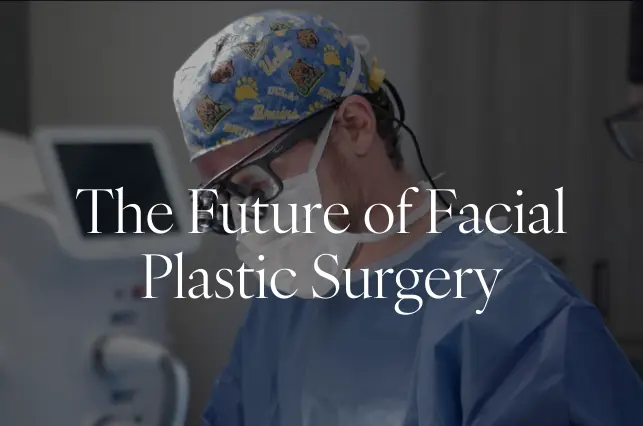
By Dr. Cameron Chesnut | 5 Codes Podcast - Listen to Episode 9 Here.
The future of facial surgery is not being driven by trends.
It is being shaped by anatomy, perception, biology, and time. The longer I operate, the clearer it becomes that the face is not a collection of features to be adjusted. It is a living, dynamic system interpreted by the brain, influenced by physiology, and judged subconsciously long before a conscious opinion is formed.
I want to share what I believe will increasingly define meaningful, durable, and desirable results, and I want to ground it in something real. Because the clearest illustration I can give you of where facial surgery is heading happened in my operating room recently, during a revision facelift case that I kept thinking about long after the procedure was done.
A Revision Case That Showed Me Everything
She was a high-performing, high-standard patient. She had found a well-regarded local surgeon, someone with a strong reputation and genuine word-of-mouth behind them. The procedure she received was comprehensive. Everything we did together was a revision: not fixing catastrophe, but updating what had been missed.
What she told me in consultation was one of the most accurate self-assessments I have ever heard from a patient:
"I feel like the surface is tight now, but everything underneath is still sagging."
She was exactly right. And that single sentence captures where facelift surgery has been, where it is now, and where it has to go next.
Her prior surgeon had tightened the exterior envelope of her skin. Competently. But the deeper layers, the structural layers, had not been addressed. The result was a face that had been acted upon at the wrong depth. The surface was tight. Everything below it continued to descend.
When I was revising her, I was focused on something beyond what we typically call a deep plane facelift. And that focus is what I want to explain.
The Evolution of Facelift Surgery (And Where It Is Going)
Facelift surgery has evolved in distinct generations, each one going deeper than the last.
The first generation worked on skin alone. Pull it tighter, trim the excess, suture it in a new position. The results were often dramatic immediately after surgery and aged poorly over time. This is where the "windswept" look that most people associate with obvious facelifts came from. The skin was tighter. Nothing structural had changed.
The second generation added the SMAS: the fibromuscular sheet that connects the skin to the deeper facial muscles. Addressing this layer was a genuine advancement. Results lasted longer and looked more natural.
The third generation is the deep plane. A thorough deep plane facelift goes beneath the SMAS entirely, working in the plane between that layer and the deeper facial structures. This allows the key retaining ligaments of the face to be released, with the structures that anchor soft tissue and resist lifting. When those ligaments are released, the entire soft tissue unit moves as a cohesive structure rather than having layers pulled independently. This is becoming the standard, and rightly so. It obeys embryologic cleavage planes. It is the way to do it.
But there is a fourth generation of the facelift. And that is what she showed me.
Even in a thorough deep plane dissection, there is a floor: a deep fascial layer that exists below the plane of dissection. In some patients, particularly those presenting for revision or those with more advanced structural aging, that floor shows laxity too. The surface is addressed. The SMAS is addressed. The deep plane is addressed. And the deepest layer is still lax.
This is the next frontier: identifying when the deep fascial floor needs to be tightened, understanding the anatomy of that layer, and addressing it in a way that complements the rest of the dissection. It is not about going deeper for the sake of it. It is about looking at every layer the face has and asking honestly what each one needs.
She exemplified this. Her exterior envelope was tight. Her deep structures were lax. The revision required focusing not on her surface, but on bringing the foundation up to match it.
The Buccal Fat Pad: What Most Surgeons Are Getting Wrong
The same patient illustrated something else I think about constantly, which is an area of persistent confusion in the cosmetic world that leads to genuinely poor outcomes.
She had fullness at the corner of her mouth that had not been addressed by her prior procedure. After surgery, with her exterior tightened, it became more visible. She described it perfectly: it looked like she had nuts stuffed in her cheek.
Her prior surgeon, during a follow-up visit, told her it was a perioral mound. The proposed solution was to go inside the mouth and debulk the underlying muscle. That would have been the wrong operation entirely, because it was not a perioral mound and it was not a muscle. It was her buccal fat pad.
The buccal fat pad is a deep, encapsulated fat structure that descends with age, migrating forward and downward to create fullness at the corner of the mouth. As it moves, it leaves a hollow behind in the midcheek. The conventional response when surgeons recognize it is often to remove it. I understand why. The fullness is visible. Removing it addresses the fullness.
But removal is the wrong framework. The buccal fat pad is structurally valuable. It will continue to be valuable as the face ages. Removing it solves a surface problem while creating a long-term one — accelerating the hollowed, skeletal appearance that comes with significant facial aging.
My approach is to lift it. I reposition the buccal fat pad back to where it used to live, through an incision placed entirely inside the mouth. No external incision. No visible trace. The fullness at the corner of the mouth is addressed not by subtracting tissue, but by restoring it to its correct anatomical position.
This is the same philosophy that drives everything else in how I operate: when things fall, they should be lifted, not cut out. Anatomy that has descended belongs somewhere. The job is to understand where it came from and return it there.
What This Means for Facial Surgery Going Forward
These two things, the deep fascial floor and the buccal fat pad, are specific. But they represent something broader about where this field is heading and what I believe will increasingly separate meaningful results from superficial ones.
Beauty is a neurologic event. Faces are processed emotionally before they are evaluated visually. Small changes in tension patterns, symmetry, or the way fat pads interact with the muscles around them can radically alter how a face is perceived. The most successful outcomes feel familiar, calm, and recognizably human because they align with how the brain expects a face to move and communicate.
Surgery begins before the incision. Physiology matters. Sleep quality, metabolic health, inflammatory tone, and intraoperative environment influence outcomes as much as technical execution. Recovery is not an afterthought. It is part of surgical design. At 5C, hyperbaric oxygen, red light therapy, and IV nutrition are integrated into recovery not as amenities but as biologic tools that affect how tissue heals.
Precision outperforms aggression. Excess tension, excess volume, and excess energy create cumulative consequences. Restraint is not hesitation. It is mastery. The best results come from surgeons who know what not to do as clearly as they know what to do.
Preservation ages better than replacement. Removing or substituting tissue with filler or biostimulators may solve a short-term concern while creating a long-term problem. Repositioning and supporting existing structure, like restoring balance with like-for-like biology, allows results to remain natural as the face continues to age. This is why stem cell-rich fat transfer fits so naturally alongside surgical lifting. It restores tissue quality from within, using living biology that integrates, adapts, and continues to improve the tissue around it.
Fillers are beginning to decline... for good reason. Migration, tissue distortion, lymphatic disruption, and long-term perception drift are now widely recognized. Public awareness is catching up to what surgeons who do revision work have observed for years. Filler migrates. It leaves biologic and mechanical signatures that influence surgery in real and measurable ways. This reality will become harder to ignore as outcome analysis becomes more refined.
Judgment is the true skill. Protocols do not operate on faces. Surgeons do. Knowing when to intervene, when to wait, and when to say no defines quality more than any device or technique. The right solution always depends on what is actually happening anatomically, not on what a patient has decided they want before being evaluated. Read More: My facial plastic surgery credentials explained.
Excellence is quiet. The best work does not announce itself. It restores presence, expression, vitality, and ease without drawing attention to the intervention. When surgery disappears, the person reappears.
The Evidence Curve Is Predictable
Many of the approaches delivering meaningful results today will follow the same trajectory as red light therapy and hyperbaric oxygen: these were both once dismissed as unnecessary or unsupported, both now backed by strong clinical evidence. The mechanisms were present and the results were visible long before the randomized trials caught up.
I have used red light for decades, before it was widely accepted. The same is true of hyperbaric oxygen in recovery. The future will look back on many current regenerative and recovery-focused interventions the same way: not as shortcuts, but as early applications of biology that arrived before consensus was comfortable with them.
The surgeons who lead the next decade will be those who understand mechanisms deeply, track real-world outcomes honestly, and adopt thoughtfully rather than reflexively. Innovation does not become standard because of a single paper. It becomes standard because it works, consistently, safely, and predictably, long before it is fashionable to say so.
Frequently Asked Questions
What is the deep plane facelift and why does it matter? A deep plane facelift operates beneath the SMAS layer, releasing the key retaining ligaments of the face so the entire soft tissue unit can be repositioned as a cohesive structure. This produces more natural, more durable results than techniques that only address the skin or the SMAS in isolation. It is rapidly becoming the standard in facelift surgery for patients with meaningful structural descent.
What comes after the deep plane facelift? The next frontier involves recognizing and addressing the deep fascial floor that exists beneath the plane of dissection in a standard deep plane facelift. In patients with advanced structural aging or revision cases, this layer shows laxity that the deep plane alone does not correct. Addressing it provides a level of structural support that produces more complete, longer-lasting results.
What is the buccal fat pad and should it be removed? The buccal fat pad is a deep, encapsulated fat structure that descends with age, creating fullness at the corner of the mouth. Many surgeons recommend removing it. The better approach, in most cases, is to reposition it, which is lifting it back to its correct anatomical location through an incision inside the mouth, with no external scarring. Removal sacrifices structurally valuable tissue and can accelerate facial hollowing over time. Lifting restores anatomy rather than subtracting it.
Why are filler results declining in quality over time? Filler is a passive volumizer that does not integrate with the tissue around it. Over time, it migrates through muscular planes, disrupts lymphatic drainage, creates inflammatory burden, and produces a kind of perception drift where the face no longer looks quite right even when no single thing is obviously wrong. These effects compound with repeated treatment and become increasingly visible to surgeons doing revision work and to patients themselves.
What makes a facelift result look natural versus surgical? Natural results come from operating at the correct depth, addressing the actual structural causes of aging rather than their surface expression, and exercising restraint in tension, volume, and intervention. A result looks surgical when the tissue has been acted upon at the wrong layer, over-tightened, or filled beyond what the anatomy supports. The goal is a face that looks like itself (rested, balanced, and familiar) not a face that looks like it has been operated on.
To learn more about how Dr. Chesnut approaches facial surgery and whether you may be a candidate, visit our deep plane facelift page or start your journey at 5C.
.avif)
Ready to begin your wellness journey?
Fax: (844) 961-3417