


Why I Don't Use General Anesthesia or Opioids for Facial Surgery
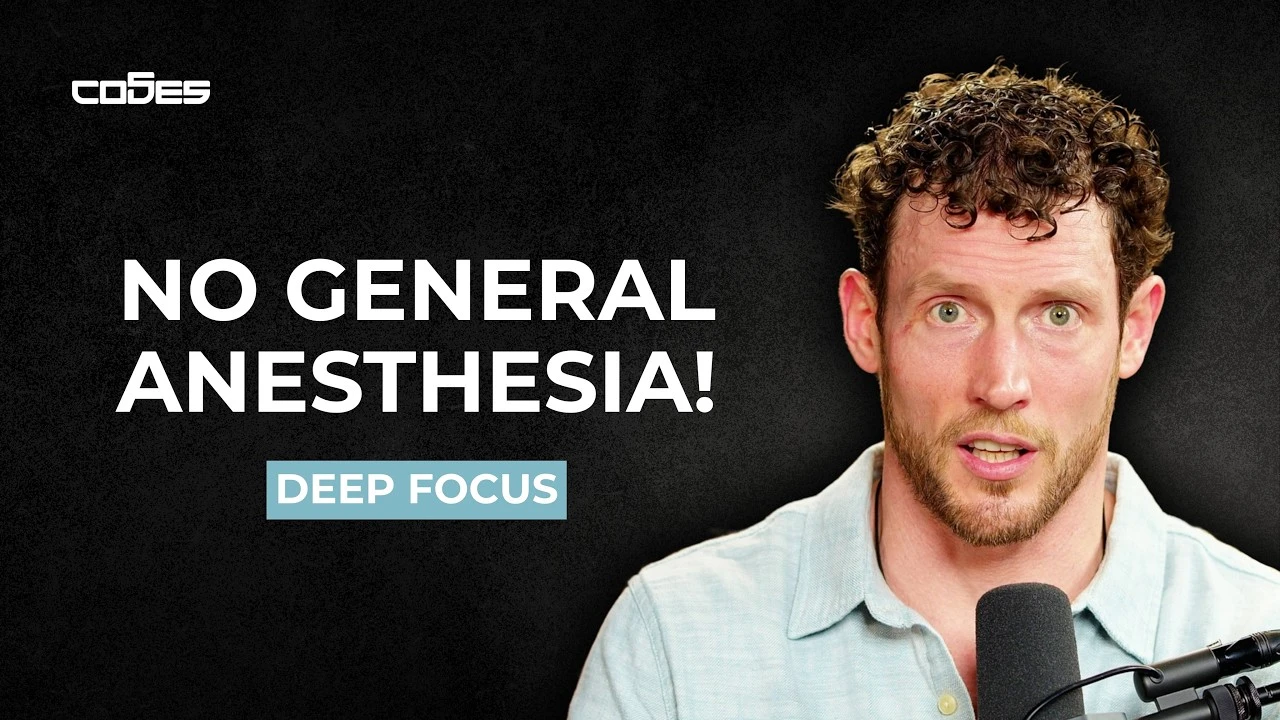
By Dr. Cameron Chesnut, MD | 5 Codes Podcast Episode 14
The most common question I get about anesthesia is not about safety. It is about recovery. People want to know why they feel foggy for days after surgery. Why their sleep is off for weeks. Why they cannot find words the way they normally do. Why the experience of recovering from a cosmetic procedure felt, in some ways, harder than the procedure itself.
The answer lives largely in the anesthesia protocol. And it is something most surgeons are not thinking about nearly enough.
My anesthesia protocol at 5C is opioid-free and benzodiazepine-free. I do not use general anesthesia for the types of facial procedures I perform. None of these individual components are novel, in fact, I did not invent any of them. What is different is the way they are assembled, the philosophy behind them, and the intention driving every decision.
This is the anesthesia protocol I would want if I were the patient. That is the standard I hold it to.
Why Do People Feel Foggy After Surgery?
Post-operative brain fog is largely driven by neuroinflammation, disrupted sleep architecture, opioid use, benzodiazepines, and inhaled anesthetic gases.
Why Conventional Anesthesia Protocols Can Disrupt Recovery
The traditional IV sedation approach pairs a benzodiazepine with an opioid, most commonly something like midazolam and fentanyl. It is common, familiar, and functional. It is also not what I would choose.
Benzodiazepines carry real risk of post-operative delirium and measurable disruption to normal brain states. Opioids create a complex cascade in the central nervous system: they promote neuroinflammation, they sensitize pain pathways in ways that can make the post-operative period more uncomfortable, and they reliably disrupt sleep architecture at exactly the moment when good sleep matters most for recovery. They can also affect basic physical functions like nausea, constipation, and cognitive fog in ways that may make the entire experience worse.
General anesthesia adds another layer. The inhaled gases used in general anesthesia are particularly associated with neuroinflammation, which is hthe mechanism behind what medicine calls post-operative cognitive dysfunction, or POCD. Most people know this as brain fog: difficulty finding words, short-term memory gaps, a general blunting of cognitive sharpness that can persist for days or weeks.
For a high-performing person undergoing an elective cosmetic procedure, trading neurocognitive function for convenience is not an acceptable exchange.
The procedures I perform do not require general anesthesia. General anesthesia would make my job easier in certain ways. It would set a predictable environment and remove variables. I have chosen not to use it because it is not what I would want, and I do not believe it is what my patients actually need.
Dexmedetomidine: How It Protects Sleep and Cognitive Recovery
Dexmedetomidine is a central-acting alpha-2 agonist that works on an area of the brain called the locus coeruleus. This is the brain's primary norepinephrine center, the part of us responsible for activation and arousal. When dexmedetomidine blunts activity there, it produces something genuinely remarkable: a brain state that closely resembles natural slow-wave sleep, complete with sleep spindles visible on EEG. It's the backbone of my anesthesia protocol.
This is not what other anesthetic agents produce. Most anesthesia suppresses the brain indiscriminately. Dexmedetomidine mimics something the brain already knows how to do.
Why that matters
During deep slow-wave sleep, the brain's glymphatic system activates. The glymphatic system is the brain's lymphatic clearance network, which is its mechanism for flushing out inflammatory mediators and metabolic waste. Dexmedetomidine supports that clearance process during the procedure itself, at exactly the moment when inflammatory signals from peripheral surgery are hitting the brain. It also protects levels of brain-derived neurotrophic factor (BDNF), which governs neuroplasticity and the brain's resilience under stress.
Perhaps most practically: by mimicking the brain states associated with natural sleep, dexmedetomidine helps preserve normal post-operative sleep architecture. The return to healthy sleep after surgery is one of the most underappreciated drivers of recovery - not just physically, but cognitively and emotionally. Protecting that architecture from inside the procedure is one of the most valuable things this agent does.
Dexmedetomidine is genuinely challenging to use well. It requires an experienced, attentive anesthesia team and a surgeon whose tissue handling and local anesthesia technique are precise enough to keep stimulation low throughout the procedure. It is not a simple protocol to execute. It is the right one.
How Low-Dose Ketamine Supports Recovery and Pain Control
Ketamine has a complicated public profile. At higher doses it is psychotropic, dissociative, and pro-inflammatory. That is not how I use it.
At low doses, ketamine is an NMDA receptor antagonist that helps control neuroinflammation, upregulates BDNF, and produces a brain-stabilizing effect that improves resilience to the stresses of surgery. It also reduces the central experience of post-operative pain. This is not by blunting the brain broadly, but by modulating the way pain signals are processed once they arrive. The result is a patient who wakes up with meaningfully less discomfort and more capacity to manage whatever remains, partly because their sleep architecture has been protected and partly because the central pain experience has already been dampened before they are aware of it.
Dose and timing are everything with ketamine. Used sparingly and strategically, it is one of the most useful tools in this protocol. The high-dose applications that give it its darker reputation are a different conversation entirely.
Why Propofol Is Used in Small, Carefully Controlled Doses
Propofol is the most recognizable name in anesthesia, and it earns its place in this protocol, in small, carefully controlled amounts. It works via GABA, produces reliable and predictable sedation, and clears the system quickly. Its fast on and fast off profile makes it a useful focal supplement when the protocol needs it.
What I am very deliberate about is the dose. Propofol at high volumes essentially becomes general anesthesia through an IV. Used at low doses as part of a broader, balanced protocol, it provides reliable amnesia and sedation without the neuroinflammatory burden of inhaled agents. It is also a strong anti-nausea agent, which matters for post-operative comfort and *importantly* for keeping blood pressure stable in the face after surgery.
How Local Anesthesia Reduces Post-Operative Pain
The most underappreciated element of this entire protocol is local anesthesia, and specifically the principle it operates on: if the peripheral pain signal is never sent, the central nervous system never has to process it.
Even under general anesthesia, cutting the skin sends a pain signal from the periphery to the brain. The brain does not consciously register it, but the pathway opens. Those open pathways contribute to post-operative pain sensitization and discomfort. By placing precise nerve blocks before I make a single incision, I stop that signal at the source. The brain receives nothing to process. The central anesthetic load required to keep the patient comfortable drops dramatically as a result.
This is a skill. Good local anesthesia technique requires genuine precision and takes time to develop. But it is what allows me to use the lowest possible doses of every other agent in this protocol, because there is simply very little stimulation reaching the brain to manage.
At the very end of every procedure, after all the surgical and regenerative work is complete, I place a long-acting local anesthetic (liposomal bupivacaine) around the key peripheral nerves of the face. This agent continues blocking pain signals for 48 to 72 hours after the procedure ends. The first two to three days of recovery, when most post-operative discomfort occurs, are covered from the periphery before the patient leaves the operating room.
What Is Suzetrigine and How Does It Block Pain?
Approved in the US in early 2025, suzetrigine works on a specific peripheral sodium channel to block pain signal transmission from the periphery to the central nervous system. The mechanism is similar in principle to local anesthesia, but highly targeted. The side effect profile is minimal. The brain remains fully protected because the intervention is happening at the periphery; the signal simply does not reach the central nervous system in the first place.
This is a medication I have been incorporating with excellent results. I expect it will become much more widely recognized as its clinical track record builds.
Additional Recovery Strategies Used in the Protocol
A few additional elements round out the picture:
Caffeine, used strategically in the pre and post-operative period, supports emergence from anesthesia, provides a modest analgesic benefit, and prevents the withdrawal headaches that can otherwise complicate recovery for daily coffee drinkers.
Post-operative nausea and vomiting (PONV) is addressed pre-operatively with medications like Emend, and supported intraoperatively by propofol's anti-emetic properties. Nausea is not just uncomfortable, vomiting after facial surgery elevates blood pressure in the face at exactly the wrong time.
Hyperbaric oxygen therapy is integrated into recovery not only for its well-documented effects on tissue healing and fat transfer survival, but for its direct impact on neuroinflammation. It reduces microglial activation in the brain and supports the clearance of inflammatory mediators, which is an unsung benefit in the context of post-operative cognitive protection.
Customized IV nutrition, calibrated to each patient's labs and genetic profile, further supports the inflammatory environment after surgery, including the blood-brain barrier integrity that is central to avoiding POCD.
How This Anesthesia Protocol Changes the Recovery Experience
The practical outcome of this protocol is a recovery that feels fundamentally different from what most people expect after surgery.
No opioid fog. No benzodiazepine hangover. Sleep that is disrupted as little as possible from the first night. Pain that has been addressed at the source before it reaches the brain, with a peripheral block that carries through the hardest days of early recovery. A brain that has been actively protected, not just avoided, throughout the entire procedure.
This is not a simple protocol to execute. It requires a precise surgical technique, an experienced and attentive anesthesia team, and a level of intraoperative attention that conventional approaches do not demand. It is also significantly more expensive than standard anesthesia, which is one reason it is rarely offered in insurance-based settings where reimbursement does not reward complexity.
I offer it because it is what I would want. That is the only standard that matters to me.
Frequently Asked Questions
Why don't more surgeons use this protocol?
It is technically demanding, requires an experienced team, and costs more to execute than conventional approaches. In insurance-based hospital settings, there is no financial incentive to use a more complex protocol when reimbursement is the same regardless. In a practice like mine, where the focus is entirely on optimizing outcomes for elective procedures, the calculus is different.
Is this protocol safe?
Yes. Every agent used in this protocol has a well-established safety profile. The absence of opioids and benzodiazepines reduces rather than increases risk in several important ways, including the elimination of respiratory depression risk and addictive potential.
Will I be awake during surgery?
No. The protocol produces a deep sedation that is effectively sleep-like. You will have no awareness of or memory of the procedure. The distinction from general anesthesia is in the depth and mechanism of sedation, not in your conscious experience of it.
What is post-operative cognitive dysfunction (POCD)?
POCD is the brain fog, word-finding difficulty, and short-term memory disruption that many people experience after surgery and anesthesia. It is driven primarily by neuroinflammation, which is a cascade that begins with peripheral tissue damage and communicates to the central nervous system via inflammatory signaling pathways. This protocol is designed at every level to minimize that cascade.
How does local anesthesia reduce post-operative pain?
By blocking peripheral pain signals before they are ever sent to the brain, local anesthesia prevents the opening of pain pathways in the central nervous system that contribute to post-operative sensitization and discomfort. Even under general anesthesia, those signals reach the brain and prime pain pathways. Stopping them at the source produces a measurably more comfortable recovery.
To learn more about the full recovery experience at 5C, visit our post-surgical recovery page or start your journey here.
🎧 Listen to the full episode on Spotify | Apple Podcasts | YouTube
.avif)
Ready to begin your wellness journey?
Fax: (844) 961-3417