


Skin Lifting vs. Skin Tightening: What's the Difference?
In cosmetics, two words are used almost interchangeably in marketing, consultations, and device branding. Those words are lifting and tightening. The problem is that they describe fundamentally different biological processes, occurring in different anatomical layers, requiring different tools. Confusing them is the source of most device disappointment, and of most misleading claims in the field.
Understanding the distinction does not require a medical background. It requires a clear map of what is actually happening beneath the surface of the skin as the face ages, and what each type of intervention can and cannot reach.
How the Face Ages, Layer by Layer
The face is not a single layer of tissue that simply loosens over time. It is a series of distinct anatomical layers, each of which ages in its own way and at its own rate.
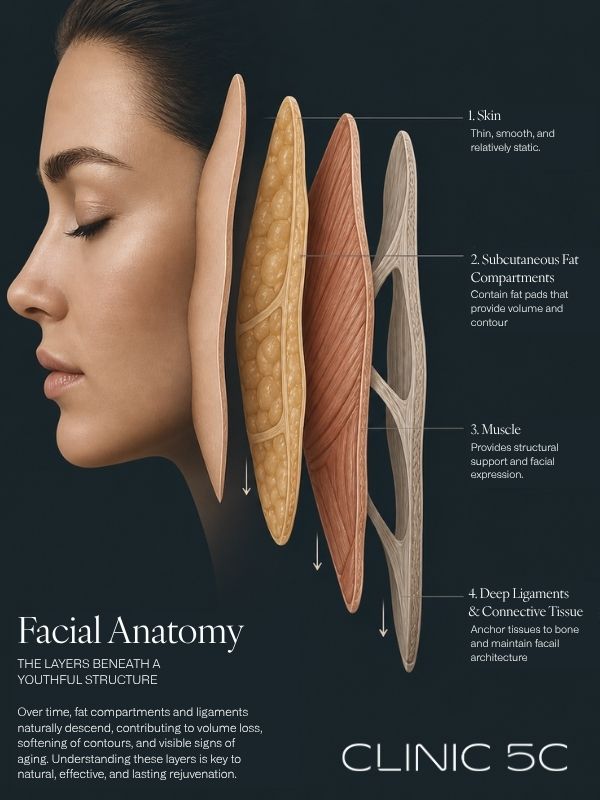
At the surface is the skin itself: the epidermis and the dermis beneath it. This is where texture lives, where fine lines form, where pigmentation changes occur, and where the quality of collagen and elastin determines how the skin looks and feels. This layer is roughly two millimeters deep at most.
Beneath the skin is a layer of subcutaneous fat, organized into distinct fat compartments across the face. These compartments do not just thin with age; they also descend, shifting downward and forward due to gravity and the loosening of the structures that once held them in place.
Beneath the fat is a fibromuscular layer, and deeper still are the ligaments and retaining structures that anchor the face's soft tissue to the underlying bone. When these ligaments loosen, the structures above them begin to descend. The nasolabial folds deepen. The jowls form. The jawline softens. This is structural aging, and it originates at a depth that neither fingers nor energy-based devices can meaningfully reach.
What Tightening Actually Means
When an energy-based device is described as tightening the skin, it is describing a real phenomenon, but one that is limited to the surface layer.
Heat delivered to the dermis causes collagen fibers to denature. As they denature, they contract and recoil. The skin's surface can close slightly around the micro-channels that ablative lasers create. New collagen production is stimulated over weeks and months following treatment. These are genuine structural changes in the dermis.
The clinical result is a reduction in the appearance of fine lines, improved skin texture and tone, and a modest reduction in the appearance of mild surface laxity. These changes are real and, with the right device used correctly, can be significant at the skin level.
What tightening does not do is move anything. The fat compartments remain where they are. The ligaments remainas lax as they were before treatment. The deeper structural descent that drives the most visible signs of facial aging continues unaddressed.
What Lifting Actually Means
Lifting is a mechanical process. It requires physically repositioning structures that have descended from where they once were. This means releasing the ligaments and retaining structures that have loosened, allowing the soft tissue above them to be moved, and then re-securing everything in a higher, more anatomically correct position.
Fat pads that have descended into the lower face can be repositioned upward. The three-dimensional volume of the midface, which flattens with age as fat moves downward, can be restored. The jawline can be redefined by addressing the deeper structural reasons it has softened.
This work happens well below the dermis, in tissue layers that no energy-based device in existence can reach with the precision and controlled effect that structural repositioning requires. Pushing energy that deep would not lift anything. It would damage the nerves, vessels, and muscles that run through those layers.
Why Old-Style Facelifts Confused the Picture
Early facelift techniques focused primarily on the skin and the tissue just beneath it. Surgeons would pull the skin tighter, remove the excess, and sew it closed. This was, in effect, aggressive surface tightening. It produced the characteristic look of older facelift surgery: pulled skin, an unnaturally tight appearance, and distorted features.
The reason those procedures created those results is precisely that they were tightening the envelope while leaving the deeper structures unaddressed. The deeper layers kept descending. Over time, the tightness at the surface and the ongoing descent below created an increasingly unnatural appearance.
Contemporary surgical approaches that work at the deepest structural layers produce results that look different because they are doing something different: repositioning the architecture rather than pulling the surface. The surface is handled separately, with devices that are suited to the surface.
The Practical Takeaway
When a device or provider promises lifting, the question worth asking is: at what depth? If the answer is that the device works on the skin, what is being offered is tightening, regardless of the word used to describe it.
Tightening has genuine value. For patients whose primary concern is skin quality, fine lines, texture, and tone, the right device used correctly can produce meaningful results. The disappointment comes not from what devices deliver, but from expectations shaped by claims they were never designed to fulfill.
A realistic conversation about aesthetic treatment begins with understanding which layer is the problem. If the concern is primarily the surface of the skin, devices are appropriate. If the concern is the structural descent of deeper tissue, devices are not the answer, and a provider who suggests otherwise does not have a complete picture of the anatomy.
Note: This content is for general educational purposes and does not constitute individual medical advice. Consult a qualified physician about your specific situation.
.avif)