


Before & After Gallery
Carly's Chesnut Journey
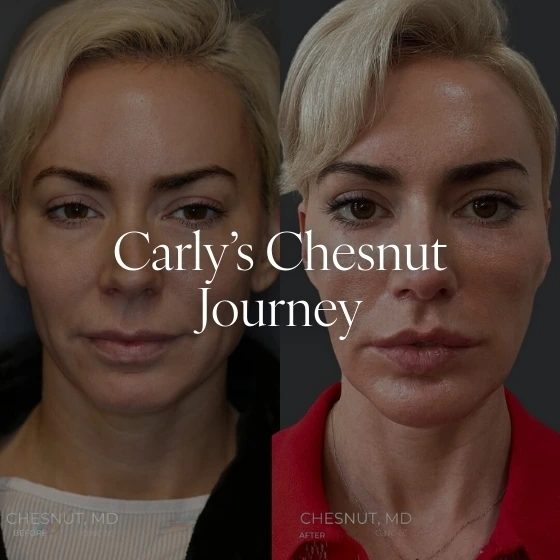
Meet Carly, Age 42
There is a particular kind of consultation that requires the most precision: the one where the patient already looks exceptional.
Where the baseline is beautiful, the changes are subtle, and the margin for error is narrow. Carly was that patient. At 42, she traveled from California with clear eyes about what she wanted and why: not to transform herself, but to stay ahead of a curve she could already see beginning to turn.
She had tried non-surgical options before reaching out. Like so many patients at this stage of the aging process, she had explored what was available without surgery and found that the results either fell short, didn’t last, or introduced new problems of their own. Filler, in particular, had accumulated in ways that were beginning to work against her natural appearance rather than for it. She arrived knowing what hadn’t worked. She was ready to understand what would.
One of the recurring questions in facial rejuvenation is timing. When is the right moment to pursue a surgical procedure? Carly’s story offers a clear answer: when you are ready, and when the anatomy still gives you options.
Doing procedures at earlier stages of the aging process is not about acting prematurely. It is about preserving the advantage of working with tissue that has not yet changed significantly. This means less intervention, more natural results, and greater durability over time.
At 42, Carly stood in exactly that window. Her concerns were real and specific, but her baseline was strong. That combination is not easier to work with. In some ways it is harder. The room for error shrinks when the improvement needs to be subtle and the starting point is already high. But it is also where the most precise and lasting work can be done.
Her primary concerns were the early changes she was tracking in her face. She saw the beginning of fat pad descent, the shift in her lip corners from accumulated filler, and a sense that certain features were beginning to drift from where they had always naturally lived. None of it was dramatic. All of it was real. And addressing it thoughtfully at this stage meant the correction could be restorative rather than reconstructive.
The surgical philosophy guiding Carly’s plan was straightforward: put things back where they belong. Not where a surgeon thinks they should be, but where they actually were before time and gravity moved them. This distinction matters enormously in patients like Carly, where the goal is to maintain a natural aging curve rather than redirect it.
A significant part of her preparation involved addressing the filler that had accumulated over time. In the outer corners of her lips, the buildup had created a hooding and protrusion, the corners overhanging the lower lip in a way that altered the natural lip shape. This kind of filler migration is common, and it is one of the reasons that ongoing filler accumulation can eventually work against the very result it was meant to achieve. Manual filler removal was built into her surgical plan from the outset, allowing the underlying anatomy to be restored to its actual position.
Fat pad repositioning was the other central element of the plan. Rather than adding volume through filler or removing it through reduction, the approach was to relocate what was already there, returning Carly’s fat pads to the positions they had occupied earlier in her life. Combined with stem cell–rich fat transfer, this approach supports long-term tissue quality and durability in a way that surface treatments simply cannot replicate.
- EnigmaLift® completely invisible access lifting procedure
- Fat pad repositioning to restore natural youthful placement
- Manual filler removal (lower eyelids and lips)
- Stem Cell Rich Fat Transfer
- Deep plane LoveLift lip repositioning
Procedural Plan
Carly’s surgery was built around a single governing principle: invisible access, visible results. TheEnigmaLift® technique allowed the full scope of her facial rejuvenation to be performed without a single incision around the ear: no visible scarring, no evidence of surgery on the surface of the skin, and no compromise to the natural contours that made her features distinctly hers.
The fat pad repositioning formed the structural core of her plan. Fat pads descend gradually with age, creating the hollowing and shifting contours that signal the early stages of facial aging. By repositioning rather than removing or adding, the result stays within the bounds of what is anatomically natural for that specific face, which is the only reliable way to produce an outcome that will continue to look right as the years pass.
Manual filler removal addressed what had accumulated in her lower eyelids and lips, clearing the slate so the new structural work could settle without prior product distorting the outcome.The lip corners, which had been pulled into an unnatural position by filler overhang, were corrected through a combination of removal and the deep plane LoveLift, a technique that repositions the lip to its natural resting place rather than simply injecting volume to compensate for displacement.
Stem cell–rich fat transfer completed the plan, restoring the qualitative dimension of her tissue health and supporting the long-term durability of the result. Together, these elements worked toward an outcome that would not announce itself, one that would simply allow Carly to continue looking like Carly, at her best, for years to come.
Carly’s recovery began, as all recoveries do, with the work happening beneath the surface before it becomes visible on it. At two to three weeks, the photos she sent from California offered a candid look at what real recovery progress looks like in the early stages. She was still significantly swollen, and these were not “after” photos by any measure. However, even at this early milestone, the lift achieved through invisible access was already visible throughout her face and into her neck. No incision around the ear. No visible evidence of how the result was achieved. Just the beginning of a change that would continue to clarify over the months ahead.
The lip correction was already showing meaningful improvement at this stage. The hooding and protrusion that had built up at the outer lip corners from prior filler were resolving, and the natural lip position, the one that had always been there beneath the accumulated product, was beginning to re-emerge.
By two months, Carly’s recovery had progressed substantially. She spoke openly about her experience: the recovery timeline, her return to work, her interactions with the clinic team, and the process of choosing a surgeon. Her account was candid and practical, and it reflected a patient who had gone in with clear expectations and found them met. She was recovering well, with the understanding that the result she was experiencing at two months would only continue to refine itself as the final healing completed.
That trajectory, steady, unhurried, accumulating, is exactly what this kind of work is designed to produce. The most precise results in facial rejuvenation are not the ones that arrive dramatically. They are the ones that arrive quietly and stay.
Carly’s story illustrates something that is easy to overlook in the broader conversation about facial rejuvenation: that the best time to address early change is before it becomes significant change. Not out of urgency or anxiety, but out of the simple recognition that earlier intervention means less correction, more natural outcomes, and results that have room to age gracefully rather than declare a departure from the past.
She came in looking like herself. She left looking like herself, only with the subtle recalibration that comes from putting things back where they belong. That is the goal. That is the result.
And at two months, with the healing still unfolding, it is already clear that it was worth the trip from California.


.avif)
Ready To Start Your Journey?
Fax: (844) 961-3417