


Insights: Why Cosmetic Surgery Cannot Fix Self-Image
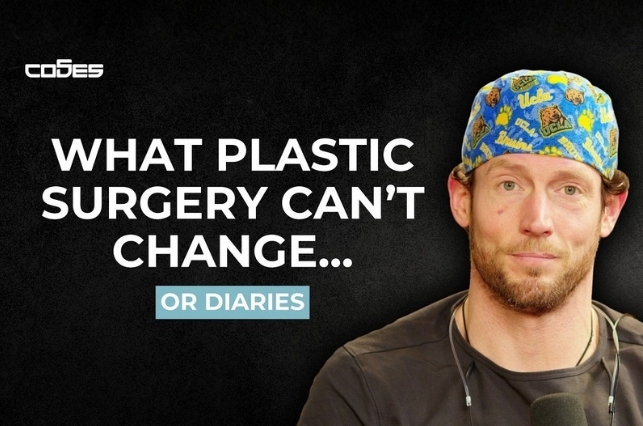
Body Image, Surgery, and the Stories We Carry
Recently in the operating room, I was reminded of something far deeper than surgical technique.
This particular week brought two separate conversations with patients that centered on body image. Not in a superficial way. In a developmental, formative, lifelong way.
It made me reflect not only as a surgeon, but as a father.
Want to Listen Instead?
→ 5 Codes Podcast on Spotify
→ Youtube: 5 Codes Podcast
.webp)
The Weight of Early Words
One of my patients shared something profoundly vulnerable before surgery. She described growing up with a father who regularly commented on her appearance. Even into adulthood, those comments continued. Over time, they shaped the way she saw herself.
She is objectively beautiful. But that did not matter.
Her internal narrative had already been written.
About a year and a half ago, I had helped her revise previous eyelid surgeries that left her in a difficult place. We worked carefully to restore normalcy. That first procedure gave her something she had not felt before: relief. A glimpse of seeing herself differently.
When she returned to discuss her face and neck, we initially hesitated. The changes were subtle. The “juice versus squeeze” question always matters in aesthetic surgery. Are we meaningfully improving something, or chasing something that may not move the needle emotionally?
But this time, she opened up.
She told me she was hoping this procedure would finally help relieve a burden she had carried since childhood. Not because surgery fixes trauma, because it does not. She was doing deeper work elsewhere. Therapy. Reflection. Growth.
But she wanted her external reflection to no longer feel like a trigger.
In the operating room, there was a gravity to that moment. Our team felt it. Before beginning, we paused. Quietly. Intentionally.
Because surgery is never just technical. It is human.
You Can Always Find the “Bad Angle”
Earlier that week, another patient reflected on growing up in Los Angeles, surrounded by distorted beauty standards. She described how that environment shaped her perception of what is “normal.”
Months ago, I recorded a video after three patient consultations in one day mentioned disliking certain neck photos of themselves. Specific angles. Certain lighting. A candid moment while chopping vegetables.
I often say this: give me ten seconds with a camera and I can find an unflattering neck angle on the most beautiful 40-year-old you know.
Cameras distort. Angles exaggerate. Lighting lies.
But here is the deeper issue. Sometimes we are not reacting to a photo. We are reacting to a lifetime of internalized messaging.
If we are only treating angles in photographs, we may be missing the true origin of the dissatisfaction.
Objective Outcomes, Subjective Satisfaction
As surgeons, we can objectively evaluate our results. I know what a technically excellent facelift looks like. I know how it will age. I know what is realistic.
But satisfaction is subjective.
A patient may be 99.9 percent improved. The question is whether they live in that 99.9 percent or fixate on the 0.1 percent.
Some patients reach a beautiful endpoint and feel free. Others focus on the smallest remaining imperfection. Neither response is about surgical quality. It is about internal baseline.
The same is true over time. Aging continues. Ideally, we blunt the curve. But when does someone feel like the result has “faded”? For one person, it may never feel that way. For another, it may feel that way much earlier.
That perception is shaped long before they ever walk into my office.
Read More: "Am I Ready For Cosmetic Surgery?"
Readiness Is Personal
I see 51-year-olds ready for surgery. I see 51-year-olds who are completely content and may not consider anything for another 10 or 20 years. I see some who felt ready a decade ago.
The anatomy may be similar.
The psychology is not.
And that distinction matters.
A Reflection as a Father
These conversations hit differently as a father of daughters.
The words we use. The standards we model. The subtle cues we give about appearance and worth. They echo longer than we realize.
Body image is not formed in adulthood. It is layered over years.
As a surgeon, I cannot rewrite someone’s childhood. I cannot erase a parent’s comments. I cannot surgically remove insecurity.
But I can be responsible about who I operate on. I can ask deeper questions. I can pause when the motivation feels externally driven. I can honor the emotional gravity when it is present.
And sometimes, I can help restore a sense of normalcy that allows someone to move forward with greater peace.
Surgery Is Not the Work. It Supports the Work.
The patient I operated on this week understood something important. Surgery was not the solution to her trauma. It was one piece of a larger journey.
That awareness changes everything.
Aesthetic surgery at its best is not about chasing perfection. It is about alignment. When the external reflection feels congruent with the internal identity, it can be profoundly stabilizing.
But it must be approached thoughtfully.
An Invitation to Reflect
Whether you are considering surgery or not, it is worth asking:
Where did your perception of your body originate?
Whose voice do you hear when you critique yourself?
Are you responding to reality, or to an old narrative?
Those answers shape not only if someone wants a procedure, but how long they enjoy it, how they evaluate it, and whether it truly feels complete.
As surgeons, we operate on tissue. But we care for people.
And people carry stories into the operating room.
.avif)