

Every Major Skin Laser Device Ranked by a Harvard Medical Fellow
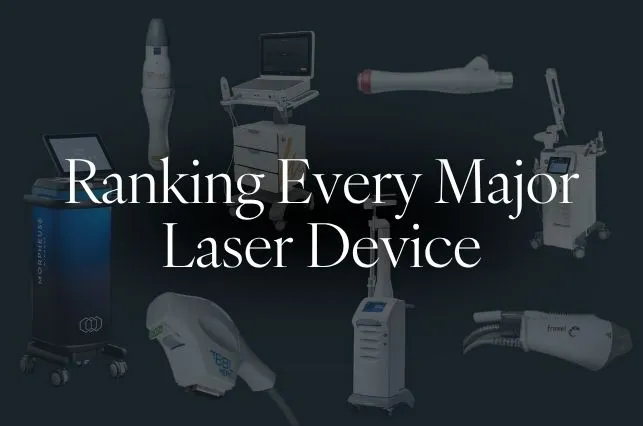
If you have spent any time researching non-surgical laser treatments, you have encountered a bewildering range of device names, brand claims, and treatment promises. CO2. Fraxel. IPL.BBL. Morpheus8. Ultherapy. Thermage. Every practice seems to lead with something different, and every device comes with its own set of before-and-after photos and compelling testimonials.
What most patients never get is a clear, ranked comparison of these devices from someone who has evaluated them at a research level rather than a sales level.
Dr. Ryan Kelm completed the Harvard Laser Fellowship at the Wellman Center for Photomedicine, which is where devices across the field are developed, tested, and understood at the deepest scientific level. What follows is his ranked list of major device categories, from most to least clinically effective, with an explanation of what distinguishes each.
Every Major Skin Laser Device, Ranked.
1. CO2 Laser: The Gold Standard
The fractional CO2 laser is the most capable resurfacing tool available. It operates at 10,600 nanometers, targeting water in skin cells, and vaporizes micro-columns of tissue with a coagulation cuff surrounding each treated channel that drives collagen remodeling.
Done at the right settings by an experienced provider, it produces results that no other device category can match. The word 'fractional' refers to the fact that the laser treats columns of tissue separated by untreated skin, allowing the intact skin between treated zones to drive healing. This fractionation approach, developed at Harvard, solved the problems of the original fully ablative CO2, which removed the entire top layer of skin and caused significant complications.
The caveat is significant: the range of how providers use this laser is enormous. A CO2 treatment done at conservative settings with topical anesthesia and two days of recovery is a categorically different procedure from a properly aggressive CO2 done under injected anesthesia with seven to ten days of downtime. Both are technicallyCO2 treatments. Only one uses the device at its actual capability. If you have been told you already had a CO2 and it did not do much, the settings are the most likely explanation.
2. Erbium Laser: Ablative, Slightly Gentler
The erbium laser is also ablative, meaning it removes tissue rather than passing through it. It operates at a slightly different wavelength, targets water with higher absorption than CO2, and produces less collateral thermal damage. This makes it slightly less aggressive than CO2, which can be an advantage for patients with less downtime tolerance or certain skin types. The tradeoff is somewhat less collagen remodeling effect. It remains an excellent tool for tone and texture in the right hands.
3. 1927 Nanometer Laser: Non-Ablative Fractional, Strong for Pigment
The 1927 nanometer laser is fractional and non-ablative, meaning it delivers controlled injury to the dermis without removing the surface. It has strong affinity for water and melanin, making it particularly effective for pigmentation concerns, tone, and some textural improvement. Recovery is shorter than ablative options, typically three to five days of peeling and redness, with less dramatic results per session but a better tolerance profile for many patients.
4. 1550 Nanometer Laser: Non-Ablative Fractional, Good for Texture and Collagen
The 1550 nanometer laser works in a similar non-ablative fractional framework but penetrates somewhat deeper into the dermis, making it more focused on collagen remodeling and textural improvement. It is often used for acne scarring, surgical scars, and general skin rejuvenation. Recovery tends to be moderate, and results build over multiple sessions.
5. Pulsed Dye Laser (V-Beam): The Vascular Specialist
The pulsed dye laser operates at 595 nanometers and targets oxyhemoglobin, the protein in red blood cells. This makes it the most effective tool for vascular concerns: redness, broken capillaries, rosacea, port wine stains, and hypertrophic scars. It is not a resurfacing device and does not significantly address texture or collagen remodeling, but for vascular targets, nothing is more precise. In a well-equipped practice, this is a distinct tool for a distinct problem.
6. 532 Nanometer Laser: Pigment and Vascular
The 532 nanometer laser targets both pigment (melanin) and vascular structures at a shorter wavelength. It is effective for brown spots, certain vascular lesions, and some pigmentation concerns. It requires a skilled operator because of the precision needed to avoid unwanted side effects on surrounding tissue.
7. IPL / BBL: Versatile but Imprecise
IPL (intense pulsed light) and BBL (broadband light) are often grouped with lasers in marketing, but they are technically different. A laser emits a single precise wavelength. IPL emits abroad spectrum of wavelengths, with filters cutting out the ranges the provider does not want to use. Everything above the filter cutoff is still being delivered to the skin.
This imprecision is why IPL is one of the most heavily litigated devices in aesthetic medicine. When treated by an experienced operator who understands exactly what is being delivered, IPL can effectively address some pigment and vascular concerns. When used by someone without that understanding, multiple chromophores that were not intended targets receive energy.
IPL is also the most common first device for new practices because it is the most affordable way to acquire something that can treat multiple concerns. A practice whose primary laser platform consists of IPL has optimized for capital efficiency, not clinical outcomes.
8. Picosecond Lasers: Tattoos and Some Rejuvenation
Picosecond lasers deliver energy in extremely short pulses, which creates a photomechanical effect in addition to a photothermal one. They are the current standard for tattoo removal because of their ability to shatter pigment particles without the collateral thermal damage of older Q-switched lasers. Some picosecond devices are also used for skin rejuvenation and pigmentation, with results that are real but generally more modest than ablative options for that application.
9. Radiofrequency Devices: Tightening with Caveats
Radiofrequency devices deliver electrical energy that generates heat in the tissue. RF microneedling devices add this thermal energy to the mechanical injury of micro needles, which is where most of the meaningful effect comes from. At the right depth and settings, RF microneedling produces real dermal tightening. The results are genuine but do not approach what ablative lasers can do for skin quality, and the device's capabilities are frequently overstated, particularly by providers who market it as a surgical alternative.
10. Ultrasound Devices: The Most Limited Effect
Ultrasound devices, which include the devices commonly marketed as non-surgical facelift alternatives, are ranked last for a reason. They deliver focused ultrasound energy to deeper tissue layers, which can produce some collagen stimulation. The effect in practice is the most limited of any major device category, and these are the devices most frequently marketed with the most exaggerated claims. Their prevalence in facelift-alternative marketing is inversely proportional to their clinical efficacy for that purpose.
How to Choose the Right Laser Treatment
Are you left wondering, "which laser treatment is right for me?" The right device depends on the layer and problem:
What laser is right for me?
- Wrinkles and deep resurfacing → CO2
- Pigmentation and sun damage → 1927 nm or IPL
- Redness and blood vessels → Pulsed dye laser
- Acne scars and texture → 1550 nm
- Mild tightening → RF microneedling
Who benefits from tightening?
- Fine lines and early skin laxity
- Texture and tone concerns
- Preventative treatments
Sometimes, the best solution is to skip lasers and go straight to facelift surgery to solve your concerns the first time. Here are a list of issues that people can identify that makes them a good candidate for surgery:
- Jowling or jawline softening
- Midface volume descent
- Structural aging changes
Therefore, there is not one single laser or treatment that's a fix-all solution. The right tool WITH the right provider can make a huge difference in reaching your skin goals, and spending your money in the right place, the first time.
The Practical Implication of This List
The most important takeaway is not which device ranks highest in isolation, but whether the practice you are considering has enough of them to make a genuine decision about what is right for you.
A practice with a CO2, a pulsed dye laser, a 1927, and a 1550 can match the tool to the actual problem. A practice whose platform is primarily IPL will find, with remarkable consistency, that whatever concern you bring turns out to be ideally suited to what IPL does. That is not clinical judgment. It is inventory management.
Note: This content is for general educational purposes and does not constitute individual medical advice. Consult a qualified physician about your specific situation.
.avif)