


When Stress Ages You Decades: What the Face Reveals About the Life Behind It
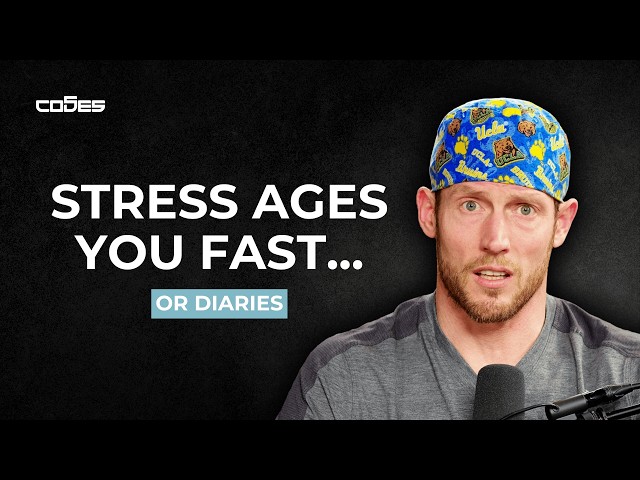
By Dr. Cameron Chesnut | Five Codes Podcast
I just came out of the operating room with a patient whose story has stayed with me all day, and I want to share it because it illustrates something I think about constantly: the face is not just a structure. It is a record.
When her preliminary photos came through, I placed her in her early 70s. When I looked at her intake information, she was 60.
That gap, roughly 15 years of apparent aging beyond her chronological age, told me something. I didn't know what yet. But I knew enough to ask.
The Conversation I Had to Have
When we got on our virtual consultation, she had already seen other surgeons. She had notes. She had recommendations. And I had questions I wanted to ask before we got to any of that.
I've learned over the years that when someone looks meaningfully older than their age, there is almost always a reason beyond genetics and sun exposure. I've seen it with cancer treatment patients, particularly those on estrogen blockers like tamoxifen, where the hormonal environment fundamentally changes how tissue ages. I've seen it in patients who've been through periods of extreme sleep deprivation, nutritional disruption, or metabolic dysregulation. And I've seen it in people who have been through something devastating.
So I asked her, directly and gently: had something really stressful happened in her life?
The tears came instantly.
I could feel the weight of it through the video call. She told me her story, and it was genuinely tragic. And she said something that I keep returning to: coming out the other side of this, I felt like I had aged decades.
She had. That is not a figure of speech. It is physiology.
What Stress Actually Does to the Face
Cortisol is the stress hormone most people know by name. But the physiological cascade of chronic, severe stress involves much more than elevated cortisol. Epinephrine and norepinephrine flood the system. Adrenal function is disrupted. Sex hormone levels shift in response, and those hormones directly govern how facial fat pads behave and how skin retains its structural integrity.
Cortisol itself is particularly disruptive to soft tissue quality. It degrades collagen and elastin. It accelerates the breakdown of the very proteins that give skin its resilience and facial fat pads their firmness. Add to that the sleep disruption that comes with grief or acute stress, the nutritional changes, the interruption of exercise and self-care routines, and the compounding inflammatory effects of a body that has been in crisis for a sustained period. You end up with tissue that looks and behaves significantly older than it is.
She personified this. Parts of her face had the quality I associate with malnutrition or prolonged metabolic disruption: a kind of depletion that goes deeper than volume loss. It was in the texture of her skin, the behavior of her fat pads, the way her upper eyelids looked hollowed rather than simply full of excess skin.
And that last detail is where the other part of her story begins.
The Wrong Recommendation, and Why It Happens
The surgeons she had seen before me had looked at her upper eyelids and recommended upper blepharoplasty: removing skin from the upper lid.
I understand why. Her upper eyelids were one of the first things you noticed when you looked at her. They looked heavy, tired, deeply aged. The upper eyelids are where we communicate how rested and vital we are. Neurologically, they are among the most information-dense areas of the face. When they look wrong, people feel it immediately even if they can't articulate why.
But here is what I saw when I looked more carefully: she did not have excess upper eyelid skin as a primary problem. She had hollow upper eyelids. She had a heavy forehead that had descended because the structures above it had lost their support. And she had significant volume loss and tissue quality changes throughout the entire upper face.
Cutting skin from the upper eyelid in that situation is like noticing that someone's nasolabial fold has deepened and deciding to cut it out rather than address why it deepened in the first place. You would never take a scalpel to a nasolabial fold while leaving the descended cheek tissue that created it untouched. But that is functionally what upper blepharoplasty would have done for her: addressing a downstream visual symptom while leaving the upstream structural causes entirely unaddressed.
She needed volume. She needed regenerative work throughout the upper face. She needed the whole forehead addressed. Skin removal would have given her a different kind of tired, a hollower, more depleted appearance, while the underlying issue remained.
This is one of the most important distinctions in facial surgery. The thing you notice is not always the thing that needs treatment. The visible symptom is downstream. Understanding what created it is the upstream question, and the upstream question requires a conversation that goes beyond photographs and a list of concerns.
What the Plan Actually Looked Like
Once I understood her story, the treatment approach became much clearer.
Yes, there were the objective structural corrections that come with a comprehensive facial procedure: repositioning what had descended, addressing the gravitational components of a decade and a half of accelerated aging. But the qualitative component here was as important as the structural one, maybe more so. Her tissue was depleted. It needed to be replenished in a deeper sense than lifting alone could accomplish.
We built the plan around a heavily regenerative focus. We used her own stem cell-rich fat transfer to restore not just volume but biological quality to the tissue. We banked some of her own stem cells for future use, because I want to be working with her long-term and I want regenerative capacity available when we need it. The fat we placed is not just filling space. It is communicating with the tissue around it, stimulating collagen and elastin production, building new vasculature, improving the skin above it in ways that will continue over the coming years.
I also enrolled her in a comprehensive recovery protocol, because the inflammatory environment in someone whose tissue has been through what hers has requires particular care. Hyperbaric oxygen, red light therapy, targeted nutritional support: all of it working together to give the surgery the best possible healing environment.
The upper eyelids, after everything above them was appropriately addressed, will look dramatically different. They may not need surgical intervention at all. That is almost always the case when eyelid concerns are actually driven by what is happening in the brow and forehead above them.
The Relationship That Made This Possible
I want to be clear about something: none of this would have happened if I hadn't asked the hard question in our first call.
If I had taken her photos at face value and proceeded to consultation with a procedure list already in mind, we would have had a different conversation, and probably a different plan. A worse one.
The willingness to ask about her life, to sit with a heavy answer, and to let that answer shape my understanding of her tissue is not separate from my surgical work. It is central to it. The face reflects the life behind it. A surgeon who doesn't understand the life is going to miss things in the face.
She was gracious enough to be vulnerable with me. I am genuinely grateful for that. It led to a relationship built on real understanding, a plan built on the full picture, and results that I believe will be meaningfully better because of it.
This is the type of patient relationship I value most. Not the consultation that moves efficiently from photos to procedure list to scheduling. The one where the conversation goes somewhere real, and everything that follows is better for it.
What This Means If You've Been Through Something Hard
If you are looking in the mirror and seeing something that doesn't match how you feel, and you suspect that a difficult period of your life is written into what you see there, it is worth saying so. Say it to your surgeon. Say it in your intake. Give the person you're consulting with the full picture.
It changes the plan. It changes the approach. It changes what's possible.
The cortisol-driven tissue degradation that comes from sustained stress is real. It is measurable in your collagen architecture, your fat pad quality, your skin's ability to hold and reflect light. It is also, at least in part, addressable. Not by removing skin from where you notice the aging most, but by understanding what depleted the tissue and restoring what was lost.
There is a version of facial rejuvenation that looks at the surface and fixes the surface. And there is a version that looks at the whole system, asks what happened to it, and works from that understanding. The results of those two versions are not the same.
Frequently Asked Questions
Can stress really age your face prematurely?
Yes, and significantly. Chronic severe stress triggers a physiological cascade involving cortisol, epinephrine, and disruption of sex hormone levels, all of which directly affect the quality of facial tissue. Cortisol in particular degrades collagen and elastin, accelerates fat pad depletion, and disrupts the skin's structural integrity. Combined with the sleep disruption, nutritional changes, reduced exercise, and lack of self-care that typically accompany severe stress, the cumulative effect on facial aging can be dramatic and rapid. Patients who have been through traumatic life events frequently present with tissue that appears ten to fifteen years older than their chronological age.
What is the difference between upstream and downstream treatment in facial surgery?
Downstream treatment addresses the visible symptom. Upstream treatment addresses what caused it. In facial surgery, the most common example is the upper eyelid: heaviness and hollowing of the upper lid is frequently caused by descent and volume loss in the brow and forehead above it. Treating the lid alone, by removing skin, does not address the cause. It changes one surface dimension while leaving the structural deficit intact. Upstream treatment identifies that the forehead and brow need to be addressed first, and reassesses the eyelid once the structures above it have been corrected. In many cases, upstream correction reduces or eliminates the need for downstream intervention entirely.
How do I know if my upper eyelid concerns are a skin problem or a volume and position problem?
This is one of the most important questions in eyelid consultation and one of the most commonly answered incorrectly in surgical practice. Upper eyelid heaviness caused by descended brow tissue or volume loss in the upper orbital area looks superficially similar to upper eyelid skin excess but responds completely differently to treatment. A surgeon who examines only the eyelid and recommends skin removal without evaluating the brow position, forehead descent, and orbital volume is treating downstream while leaving the upstream causes untouched. A thorough assessment looks at the entire upper face as a system before recommending intervention at any single point within it.
What does cortisol do to the face specifically?
Cortisol is catabolic, meaning it breaks down tissue rather than building it. In the face, elevated cortisol over a sustained period degrades collagen and elastin fibers, weakens the structural integrity of fat pads, disrupts the skin's ability to retain moisture and firmness, and accelerates the visible signs of aging. It also affects sex hormone levels, which in turn govern how facial fat pads respond to gravitational forces. The overall effect is a face that ages faster and recovers more slowly than it otherwise would.
Can a surgical procedure reverse stress-related aging?
In large part, yes, but the approach matters. Stress-related aging is not just gravitational or volumetric. It is qualitative: the tissue itself has been depleted and degraded at a biological level. A procedure that lifts and repositions without addressing that underlying tissue quality will produce results that do not fully reflect what is possible. A procedure that incorporates regenerative tools, stem cell-rich fat transfer, appropriate recovery support, and a long-term maintenance approach can address both the structural and qualitative dimensions of stress-related aging, with results that continue to improve over time as the regenerative components of the procedure keep working.
Related reading:
- Body Image, Surgery, and the Stories We Carry
- The Neuroanatomy of How We Interpret Faces
- Stem Cell-Rich Fat Transfer
- Scarless Lower Eyebag Removal
- EnigmaLift Brow Lift
- Signs You May Be Ready for Facial Plastic Surgery
- Natural Facial Rejuvenation Philosophy
- Post-Surgical Recovery at 5C
Dr. Cameron Chesnut is a facial plastic surgeon and founder of 5C. He holds a clinical teaching affiliation with the University of Washington School of Medicine. The views expressed here are his own and are not affiliated with or representative of that affiliation. This content is for general educational purposes only and is not individual medical advice.
.avif)